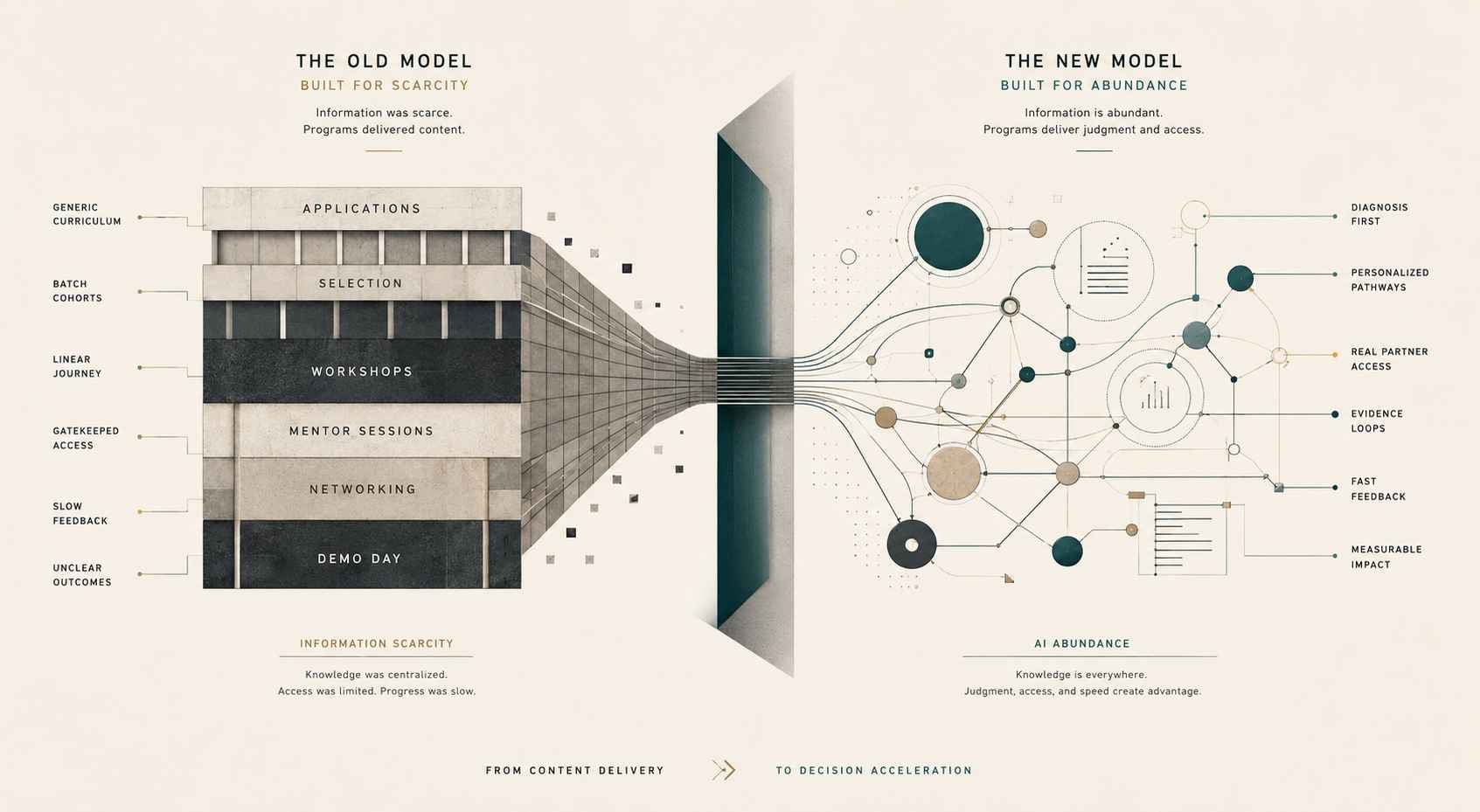
Most startup accelerators are still designed for a world that no longer exists.
They were built for a time when startup knowledge was scarce. Founders needed access to mentors, templates, investors, pitch training, market research, and basic startup language. An accelerator could bring all of that into one place and create real value.
That world has changed.
Today a founder can open ChatGPT, Claude, Perplexity, YouTube, Substack, or a podcast and get more startup advice than they can possibly process. They can generate a pitch deck, map competitors, build landing pages, write customer emails, analyze business models, and prepare investor questions in a few hours.
Information is no longer the scarce resource. Judgment is.
This is why many accelerators now feel strangely outdated. They still offer workshops, mentor calls, Slack groups, pitch sessions, and demo days as if these things are valuable by default. They are not. A workshop is not acceleration. A Slack group is not community. A corporate introduction is not market access. A mentor session is not useful just because the mentor has an impressive title. Acceleration means a startup moves faster toward evidence, customers, capital, strategic clarity, or real partnerships because of the program.
If a founder could get the same value from YouTube, a podcast, or an AI chatbot, the accelerator is not doing its job.
The Label Matters
One of the biggest problems in the ecosystem is that too many things are called accelerators.
Some are actually training programs. Some are matchmaking programs. Some are corporate scouting programs. Some are ecosystem development activities. Some are vendor discovery platforms. Some are public-sector innovation showcases.
All of these can be useful. But they are not the same thing.
If there is no capital, no structured investment path, no serious validation engine, no hands-on support, and no clear mechanism to help startups move faster, then calling the program an accelerator creates the wrong expectation.
Founders make decisions based on these expectations. They allocate time, attention, energy, and sometimes money. For an early-stage founder, this is not a small cost.
A serious program should say clearly what it is. Is it offering capital? Is it offering pilots? Is it offering market access? Is it offering investor readiness? Is it offering corporate exposure? Is it offering education?
There is nothing wrong with being a matchmaking program. There is something wrong with presenting ecosystem access, matchmaking as acceleration.
Stage Mismatch Breaks the Program
Another common problem is putting very different companies into the same room and pretending they are all startups with similar needs.
A two-month-old MVP team, a company with six years of operations, and a mature business looking for regional sales access do not belong in the same generic journey.
The early-stage team needs validation, pre-seed capital, sharp feedback, and founder discipline. The MVP-stage startup needs pilots, customer feedback, and product refinement. The mature company may simply need sales channels, procurement access, or regional expansion.
When these companies are mixed without proper segmentation, the mature companies naturally dominate the room. They are easier for partners to understand. They look less risky. They have products to show. They can answer questions more confidently. But that does not mean they are better accelerator candidates. It may only mean they are better vendor candidates.
A world-class accelerator must know whether it is accelerating startups, sourcing vendors, or showcasing innovation. These are different jobs, and confusing them weakens the whole system.
Corporate Partners Need a Thesis
Corporate participation is another area where accelerator design often fails. Many programs bring corporate partners into the room without preparing them properly. The partner representative may be intelligent, polite, and senior enough to attend, but not senior enough to decide.
They may describe what their company already does, but not what the company is willing to explore. That is not an innovation thesis.
An innovation thesis should define what the corporate is looking for, what it is not looking for, what problems matter, what stage of startup it can work with, what budget or pilot pathway exists, and who has authority to move things forward.
Without that, founders are pitching into fog. The corporate listens. The founder explains. Everyone is polite. Then nothing happens.
A corporate partner without a clear innovation thesis turns an accelerator into a networking event with a famous logo.
Founder Time Is Not Free
Accelerators often underestimate the cost of founder time. Early-stage founders are short on almost everything: money, people, credibility, focus, emotional energy, and certainty. But the most precious resource is time.
Every session should have a clear reason to exist. Every meeting should have an outcome. Every founder should know why they are there and what they are supposed to get from it. Attendance should not be treated as commitment if the session itself is not valuable.
A founder sitting silently in a vague online meeting is not being accelerated. They are losing time they could have spent talking to customers, building the product, testing assumptions, or finding capital. A serious accelerator should earn founder attention, not extract it.
Community Is Not a Channel
Many programs create a Slack or WhatsApp group and call it a community. But community does not happen because a channel exists. Community happens when people have shared urgency, shared problems, repeated useful interactions, and enough trust to be honest.
If the cohort is too fragmented by stage, geography, motivation, and maturity, there may be polite conversation, but little real community. Founders do not bond deeply because they were added to the same workspace. They bond because they are fighting similar battles.
Community is not software. It is repeated value between people who have a reason to care about each other.
The First 48 Hours Matter
The first 48 hours after acceptance are more important than most programs think. That is when trust is either built or weakened.
A world-class accelerator should immediately reduce ambiguity. Founders should know the timeline, selection criteria, funding structure, expected workload, official communication channels, partner roles, data access rules, and what happens next.
They should not have to guess who is running the program, why unfamiliar people are contacting them, whether surveys are anonymous, or which calendar invite is official. Startups already live with uncertainty. The accelerator should not add more. Operational confusion becomes strategic distrust.
AI Has Raised the Standard
AI has made weak accelerator design more visible. Generic startup education has lost much of its value. Founders can now access basic knowledge instantly. This does not make accelerators irrelevant. It makes them more important, but only if they evolve.
The future accelerator should not compete with AI on information. It should use AI to handle what AI is good at: administration, FAQs, document preparation, research summaries, pitch review, market mapping, and basic startup education.
Then human experts should focus on what is still scarce: judgment, trust, founder psychology, customer reality, investor conviction, and strategic decision-making.
AI can generate options. But someone still needs to help founders decide what matters.
The Future Accelerator Is a Decision Engine
The best accelerator of the future will not be a calendar full of sessions.
- It will be a startup support engine.
- It will begin with diagnosis, not workshops.
- It will segment startups by stage and need.
- It will prepare partners before exposing them to founders.
- It will protect founder time.
- It will make funding expectations clear.
- It will use AI where AI creates leverage.
- It will design trust as infrastructure.
- And most importantly, it will help founders make better decisions faster.
After more than fifteen years of designing and running startup support programs, and after recently experiencing accelerator systems again from the founder side, my conclusion is simple:
Most accelerators do not have a people problem. They have a systems problem.
The people behind these programs are often hardworking and sincere. The issue is not effort. The issue is architecture. Accelerators were built for a world where startup knowledge was scarce.
That world is gone. The next generation of accelerators must be built for a world of AI abundance, founder distraction, weak signals, and overwhelming noise.
- The future accelerator is not a classroom.
- It is not a networking event.
- It is not a demo day machine.
- It is a decision engine.