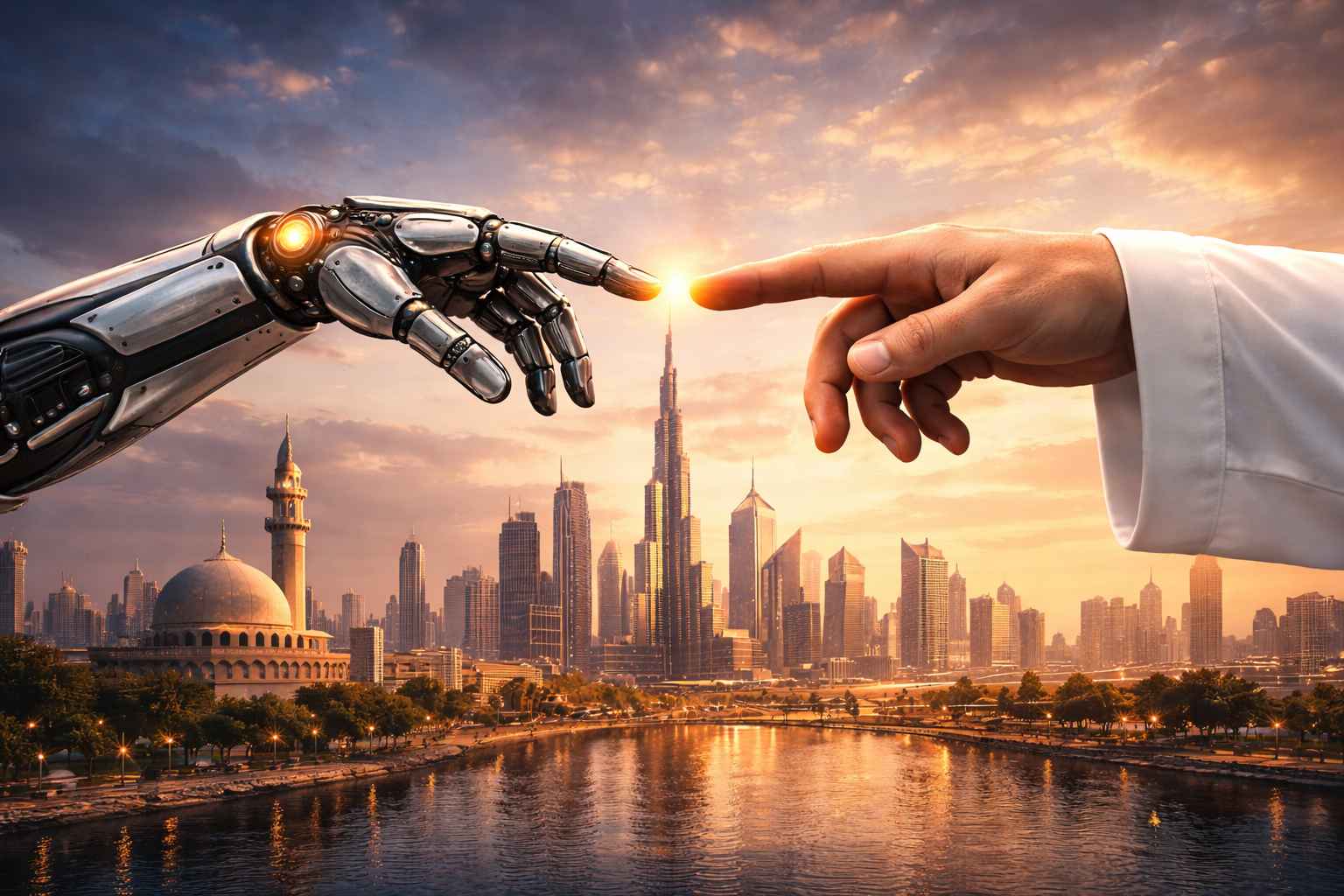
Something strange is happening in the global conversation about artificial intelligence.
Every week we hear announcements: AI strategies, AI ministries, AI campuses, AI accelerators, AI-powered everything. Governments and corporations alike speak the language of transformation. The GCC in particular has positioned itself as one of the most ambitious regions in the world when it comes to AI. Massive funds are allocated, partnerships with global tech giants are announced, and glossy headlines promise a new knowledge economy.
And yet, beneath the surface, a quieter question lurks: How much of this is actually innovation? Because adopting technology and innovating with technology are not the same thing.
The Difference Between Using AI and Creating Innovation
Innovation is often misunderstood as the introduction of new technology. But technology is only a tool. Innovation is what happens when that tool reshapes systems, behaviors, incentives, and markets.
Most AI initiatives today operate at the tool layer.
Companies integrate chatbots. Governments deploy predictive analytics dashboards. Enterprises purchase AI APIs from global providers and build small applications around them (wrapper apps). These projects are often useful, sometimes impressive, and occasionally even transformative for internal processes.
But they rarely change the structure of value creation.
Real innovation would mean:
- New business models built around AI-native capabilities
- Entirely new services that did not previously exist
- Organizational structures designed around AI-human collaboration
- New market categories emerging from local ecosystems
Instead, what we mostly see is AI-enabled optimization, not AI-driven transformation. And optimization, while valuable, is not the same as innovation.
The GCC’s AI Moment
The Gulf region is fascinating in this regard. Countries like the UAE and Saudi Arabia have moved with remarkable speed. National AI strategies, sovereign funds investing in frontier technologies, and partnerships with global leaders such as Microsoft, OpenAI, and Nvidia signal a clear ambition: to position the region as a global AI hub.
In many ways, this ambition is admirable. The region has several structural advantages:
- Strong government coordination
- Access to capital
- The ability to move quickly at national scale
- A willingness to experiment with new technologies
But these same strengths can also create an illusion, because when large budgets meet powerful technologies, activity can easily be mistaken for innovation.
The Infrastructure Trap
Much of the current AI narrative in the GCC revolves around infrastructure: data centers, GPU clusters, AI universities, research labs, and strategic partnerships.
These are important building blocks. No serious AI ecosystem can exist without them. But infrastructure alone does not create innovation ecosystems.
Innovation emerges from messy, decentralized experimentation. Startups failing and learning. Entrepreneurs discovering unexpected applications. Markets shaping which ideas survive and which disappear.
Infrastructure can support that process. It cannot replace it.
A country can build the most advanced AI campus in the world and still produce very little real innovation if the surrounding ecosystem does not generate problem-driven experimentation.
The Adoption Economy
Another reason the illusion emerges is that the current AI wave is dominated by platform technologies. The core models are largely developed by a small number of global companies. Most organizations around the world, including those in the GCC, are therefore adopters, not creators, of foundational AI.
This is not necessarily a problem.
Very few countries produce operating systems, semiconductor architectures, or internet protocols. Yet many have built successful digital economies on top of them.
The challenge arises when adoption is framed as innovation leadership.
Building applications on existing AI models is valuable. But calling it a national AI revolution can distort expectations and policy priorities.
True leadership would require deeper capabilities:
- Advanced AI research
- Proprietary datasets and domain models
- AI-native startups scaling globally
- Local talent ecosystems producing original breakthroughs
These things take time. Often decades. The question is how patient and prepared are you?
The Talent Reality
Perhaps the most underappreciated constraint is human capital. AI ecosystems are fundamentally talent ecosystems. The world’s most successful innovation clusters, from Silicon Valley to Shenzhen, are dense networks of engineers, researchers, founders, and investors interacting continuously.
Money can accelerate infrastructure. But talent density grows slowly.
Many GCC countries are investing heavily in education and global recruitment, which is a smart strategy. Yet importing talent is different from cultivating long-term innovation cultures.
Sustainable ecosystems emerge when people build companies, fail, learn, start again, and mentor the next generation. That cycle cannot be purchased. It has to evolve.
The Real Opportunity
I don't mean that the GCC’s AI ambitions are misguided. Quite the opposite. The region has a unique opportunity to shape applied AI innovation in sectors that matter deeply to its future:
- Energy transition
- Climate adaptation in arid environments
- Smart cities and urban infrastructure
- Logistics and global trade corridors
- Healthcare delivery across distributed populations
These domains contain real, complex problems, and real innovation tends to grow where technology meets genuine problem pressure. So if the region focuses less on the spectacle of AI and more on problem-driven experimentation, it could produce meaningful breakthroughs that the rest of the world has not yet explored.
The Cultural Layer of Innovation
The deeper issue is cultural. Innovation is not a technology phenomenon. It is a behavioral system. It depends on:
- Tolerance for experimentation
- Permission to challenge existing models
- Incentives that reward learning rather than only success
- Organizations willing to rethink how they operate
Without these conditions, AI simply becomes another layer of software, a very powerful layer of software, certainly. But still software.
A Quiet Test
The coming decade will quietly reveal whether today’s AI enthusiasm represents a genuine transformation or simply a technological wave passing through existing structures.
The test is simple: Will AI produce new companies, new markets, and new ways of working? Or will it mostly produce better dashboards and more efficient processes?
One outcome is optimization, but the other is innovation. They might look similar at the beginning, but over time, the difference becomes impossible to miss. And the regions that understand this distinction early will be the ones that shape the future rather than merely adopt it.