The UAE showed resilience under pressure, but the deeper question is whether Gulf businesses will protect innovation when survival instincts take over.
There are places in the world where war is tragically imaginable. And then there are places like Dubai, where the deeper shock is not only danger, but disbelief.
Dubai was built, economically and psychologically, on continuity. It sells order, functionality, mobility, and the promise of distance from the region’s recurring instability. So when conflict suddenly becomes audible through phone alerts, distant blasts, flight disruptions, and people scanning the sky for what should never have entered daily life, the first rupture is not merely operational. It is emotional.
This was not supposed to happen here. Indeed one of the most important words one can not hear enough in the the Gulf region is "Stability".
And yet, when the recent US - Israel - Iran conflict widened into the Gulf, the UAE did something important: it held. Missiles and drones shot form inside Iranian border were intercepted over Gulf states including the UAE, and residents in Dubai reported hearing blasts and rushing to make sense of an event that felt previously unthinkable. Still, the country did not descend into chaos. Core systems continued functioning, and the UAE’s broader capacity for continuity was visible under pressure. A fragile ceasefire announced in early April has since created a temporary pause, though the wider conflict is clearly unresolved.
That resilience deserves to be recognized. But resilience should not be confused with normality. Reports from Dubai in the aftermath described panic buying, quieter streets, temporary changes in work arrangements, and a meaningful shift in how residents, visitors, and markets perceived the city’s long-protected safe-haven status. Tourism and travel were also hit, with cancellations rising sharply in the UAE after the conflict escalated and broader Gulf tourism forecasts being revised downward because of safety concerns and transport disruption.
The interesting thing about stress in highly functional places is that it often hides in plain sight. The city continues, but the nervous system of the city changes.
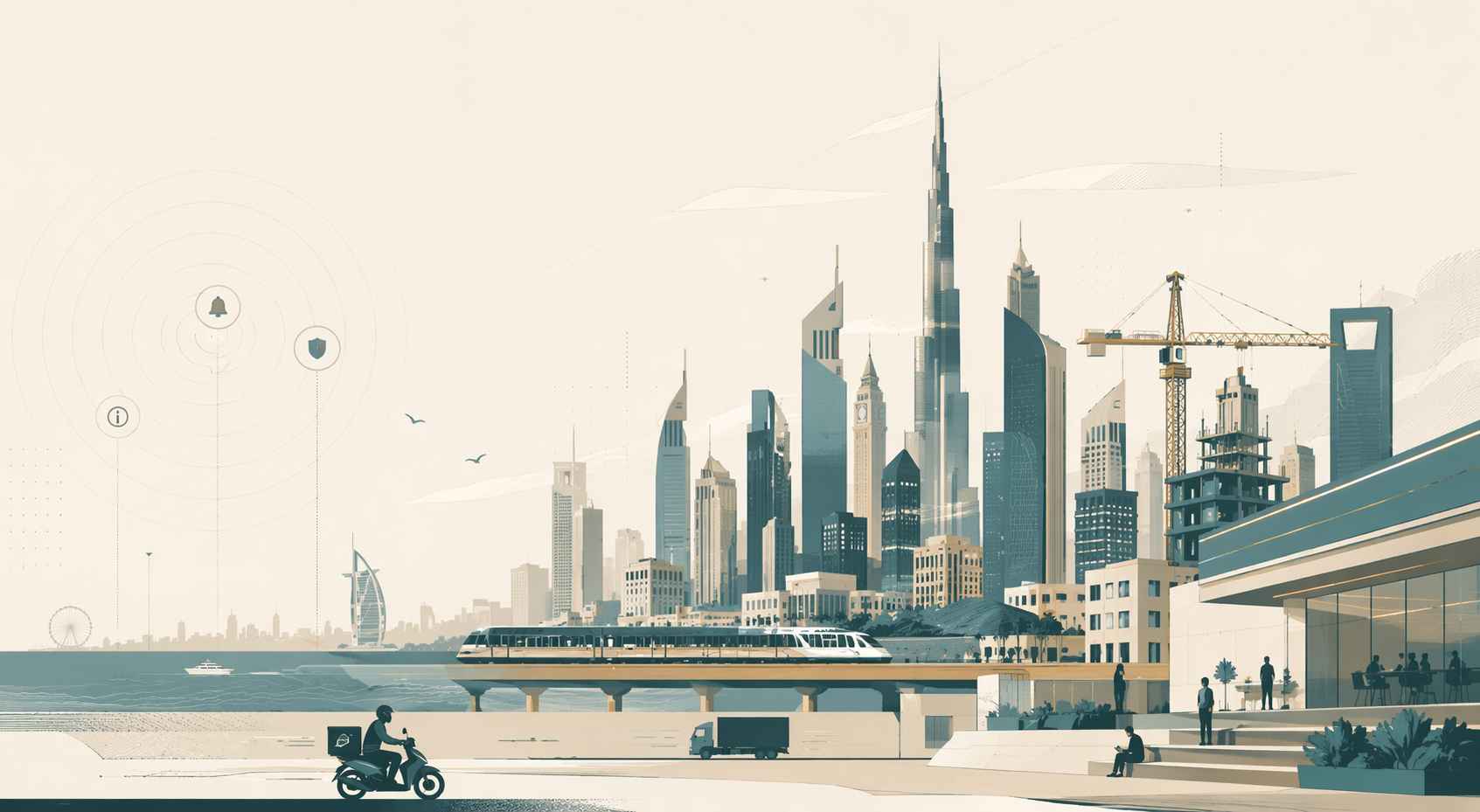
I could see that contradiction everywhere. Construction workers paused, looked up, and then returned to work. Delivery riders stayed on the roads. Residents, tourists, and locals gradually adjusted day by day as the immediate shock softened into routine vigilance. Yet public life also seemed subtly thinner. Malls felt less crowded. Nightlife and strolling areas felt quieter. Some companies reportedly told employees to leave temporarily and continue remotely from abroad. Outward continuity coexisted with inward strain.
That is the atmosphere many Gulf businesses are operating inside now: not collapse, not normality, but a functioning system absorbing stress in real time.
And this is exactly when innovation becomes vulnerable
In uncertain times, most organizations become defensive. That reaction is natural. They conserve cash, delay expansion, postpone experimentation, and prioritize operational survival. Innovation budgets become easy targets because innovation is often treated as a layer that sits above the real business rather than inside its future survival logic.
When executives get nervous, innovation starts to look optional. Interesting, but not urgent, almost like a luxury we can postpone. Something to return to when conditions stabilize.
That instinct may be understandable. But in the Gulf, it can also be a serious strategic mistake.
The GCC, including the UAE, has spent years trying to build a future less dependent on hydrocarbons. This has never been only an economic story. It has also been a capability-building story: creating startup density, attracting technical talent, funding new ventures, sponsoring experimentation, supporting innovation units, building accelerators, encouraging applied technology, and making entrepreneurship feel culturally and institutionally possible.
All of that depends on continuity. Innovation ecosystems are not built only by money. They are built by momentum, confidence, concentration of talent, repeated experimentation, institutional sponsorship, and the belief that tomorrow is worth investing in even before it becomes fully legible.
When crisis hits, that machinery can slow down very quickly. And once it slows down, restarting it is not automatic.
The deeper risk is regression, not interruption
The short-term damage of conflict is easy to see: weaker tourism, slower footfall, disrupted flights, more cautious consumers, more hesitant investors. The long-term damage is subtler. It appears when organizations quietly drift back toward the familiar logic of defensive incumbency.
Under pressure, systems protect what already works. In the Gulf, that often means assets, sectors, and revenue streams with immediate certainty. It means leaning back toward the old economic center of gravity. For countries whose diversification strategies were built precisely to reduce dependence on oil, that regression matters.
If innovation activity shrinks every time the region enters a serious period of instability, then diversification remains conditional. And if diversification remains conditional, oil remains the default fallback logic of the economy.
That is the real danger. Not that one accelerator slows down or one fund delays a decision. The danger is that the region gradually teaches itself, again and again, that innovation is for calm periods, and extraction is for difficult ones. Over time, that creates a culture where long-horizon capability is always the first sacrifice and never the protected core.
Once that pattern becomes normal, rebuilding innovative momentum becomes much harder. Founders relocate. High-agency operators leave. Venture pipelines thin out. Corporate champions of experimentation lose internal legitimacy. Early-stage investment committees become more conservative. The critical mass that makes an ecosystem feel alive starts to dissolve at the edges.
But entrepreneurs are built for ambiguity
This is what many large institutions misunderstand. Entrepreneurs, venture builders, and innovation operators are not creatures of certainty. They are, by necessity, people who learn to act under incomplete information, shifting constraints, scarce resources, and moving assumptions. They work in ambiguity not because they enjoy instability, but because building anything new requires the ability to move before clarity is complete.
That does not make founders immune to war, fear, or disruption. Of course not. It does mean, however, that periods of uncertainty are not arguments against innovation. In many cases, they are precisely when innovation capability becomes most useful.
Not all innovation, of course. Crisis tends to expose the difference between innovation theater and actual problem-solving. It becomes harder to justify symbolic pilot projects, vanity partnerships, or fashionable experimentation that was never tied to meaningful capability in the first place. But practical innovation, resilience-oriented innovation, and disciplined early-stage building become more relevant, not less.
This includes the kinds of ventures and internal projects that help organizations operate under pressure: logistics resilience, fintech infrastructure, operational AI, industrial technology, health systems, workforce tools, supply chain visibility, distributed services, and products that reduce fragility in moments of stress.
The right question, then, is not whether innovation should continue during instability. It is what form of innovation deserves protection when the environment turns hard.
What smart Gulf institutions should do now
The current ceasefire does not resolve the strategic question. It only creates room to ask it more clearly.
Governments, investors, corporates, and ecosystem builders across the Gulf should avoid two equal and opposite mistakes. The first is denial: pretending nothing changed because the city remained functional. The second is panic: treating all long-term bets as expendable because the environment no longer feels secure.
The more mature response is selective protection.
Protect the innovation efforts that build real capability. Protect the teams that carry institutional learning. Protect the founder pipelines that give the region future optionality. Protect the talent density that took years to attract. Protect the ventures most likely to improve resilience, adaptability, and post-oil competitiveness. And cut, if necessary, the ornamental layer: the programs, pilots, and narratives that were always more performance than substance.
That distinction matters now more than ever.
The UAE has shown that a modern Gulf economy can remain operational under serious stress. That is not a small achievement. But resilience is not only the ability to keep roads open, towers lit, airports moving, or services running. Real resilience is also the ability to preserve long-term developmental intent when short-term fear becomes politically and financially tempting.
The Gulf has spent years saying that innovation is strategic. Moments like this reveal whether that was ever fully true. If innovation is treated as a luxury every time the region is tested, then it was never strategy. It was surplus. And if that is the lesson organizations absorb from this crisis, the region may keep its physical infrastructure intact while quietly weakening the capabilities that were supposed to define its future.
That is why this moment matters. Not because the war fully stopped life in the UAE. It did not. It matters because it forced a more serious question to the surface:
When pressure rises, what does the Gulf truly consider essential to its future?