In MENA, family businesses do not usually misunderstand technology. They misunderstand transformation.
That sounds like a small distinction. It is not. It is the whole game.
Too many family businesses still treat digital transformation as a portfolio of tools: ERP, CRM, e-commerce, apps, dashboards, cloud migration, AI pilots. But the research is clear: digital transformation is not a technology rollout. It is a process of strategic renewal and organisational change that alters how value is created, how decisions are made, and how the business is governed. [1] [2] [3]
That misunderstanding matters more in MENA than in many other regions because family firms are not marginal actors here. They are a structural force. In the UAE, official figures say family businesses contribute around 60% of GDP, account for more than 80% of employment, and represent nearly 90% of private-sector companies. Across MENA more broadly, research cited in the source material estimates that family firms contribute roughly 60% of regional GDP on average. [4] [5]
The Category Error at the Center
The deepest problem is not lack of ambition. It is a category error.
Family businesses often interpret a socio-technical transformation as a technology project. If a family business believes digital transformation means “installing systems,” it will make the wrong decisions about budget allocation, leadership, pace, talent, incentives, and governance. [1] [2]
This is where many transformation efforts quietly go sideways.
A software project feels legible. It comes with vendors, milestones, budgets, and committees. It has the reassuring smell of control. But transformation does not only ask a company to modernize tools. It asks it to rethink value creation and organisational design. Firms that manage transformation like a systems rollout may produce digital outputs without producing real digital outcomes. [1]
Many family firms also confuse digitisation with transformation. The distinction matters. Digitisation is converting analogue information into digital form. Digitalisation is using digital technologies to change parts of the business model and generate new value. Digital transformation is broader still: a fundamental change in form, function, structure, and value creation. [2] [3]
Why Family Businesses Get Trapped Here
The misunderstanding persists because it is produced by the logic of family firms themselves: preserving family control, protecting identity, minimizing risk, and operating in governance structures where ownership and control are tightly coupled. [6]
Transformation threatens more than process. It threatens familiar patterns of authority.
Many family firms are coordinated through trust, proximity, intuition, and relational authority. That can be a strength. But digital transformation pushes the firm toward data accountability, transparency, formal process, and distributed decision-making. It changes what becomes visible, what becomes measurable, and who can legitimately decide.
This is why the issue is not just digital maturity. It is existential comfort with redesign.
One of the sharpest conclusions in the research is that digital transformation is often treated as a procurement programme, when in fact it is a governance and capability programme that changes decision rights, incentives, data accountability, and the way the business creates and captures value. [1]
Why This Tension Becomes Sharper in MENA
MENA amplifies the issue because the regional context itself is structurally paradoxical.
Governments are pushing digitisation, regulatory modernization, AI agendas, smarter infrastructure, and platform-native economic development. Consumers in Gulf markets are digitally sophisticated. Competition increasingly comes from faster, more data-driven, and more integrated business models. Yet many legacy firms still operate within governance cultures shaped by concentrated ownership, family and state influence, and a continuing push toward greater transparency and formalisation. [7] [8]
A data-driven operating model is not culturally neutral. For many legacy family groups, it implies a redistribution of visibility and control. That can feel less like modernization and more like exposure.
The Intent–Action Gap
The strongest regional pattern is not resistance to digital. It is the gap between stated intent and real follow-through.
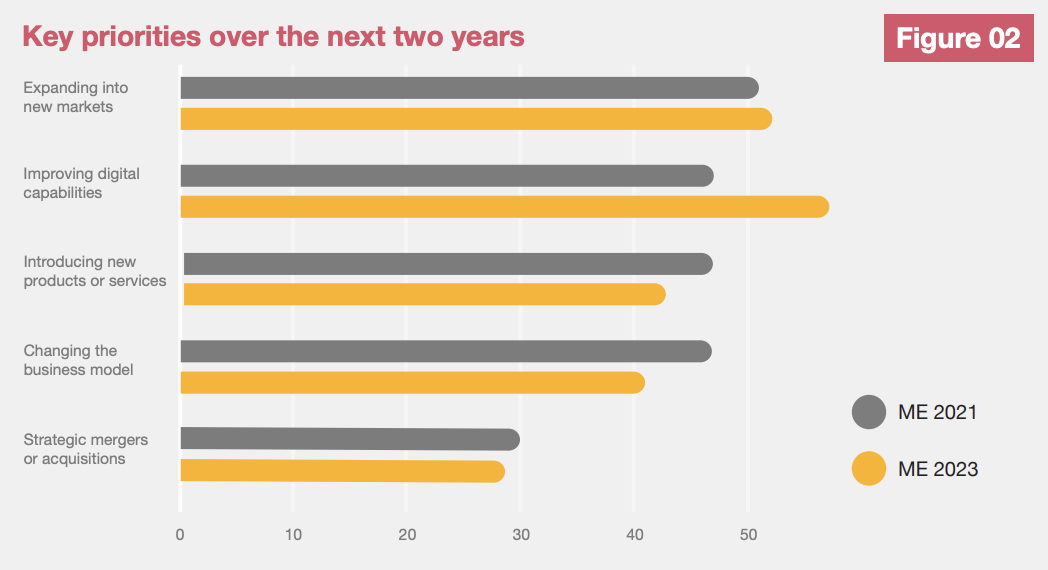
PwC’s Middle East Family Business Survey found that 57% of respondents prioritised improving digital capabilities. On the surface, this looks encouraging. But a later Dubai-focused NextGen study warned that this digital intent is “not matched with positive action,” especially around GenAI. [9] [10]
That pattern matters more than the headline numbers. It suggests that the problem is not aspiration. It is translation. Family firms know they must change. But many still do not know how to convert digital ambition into governance reform, capability building, and business-model renewal.
The NextGen Illusion
Many family businesses assume the NextGen will carry digital transformation forward. That only works if the NextGen is given actual authority, budget, measurable responsibility, and decision rights. Otherwise, digital becomes symbolic. [10]
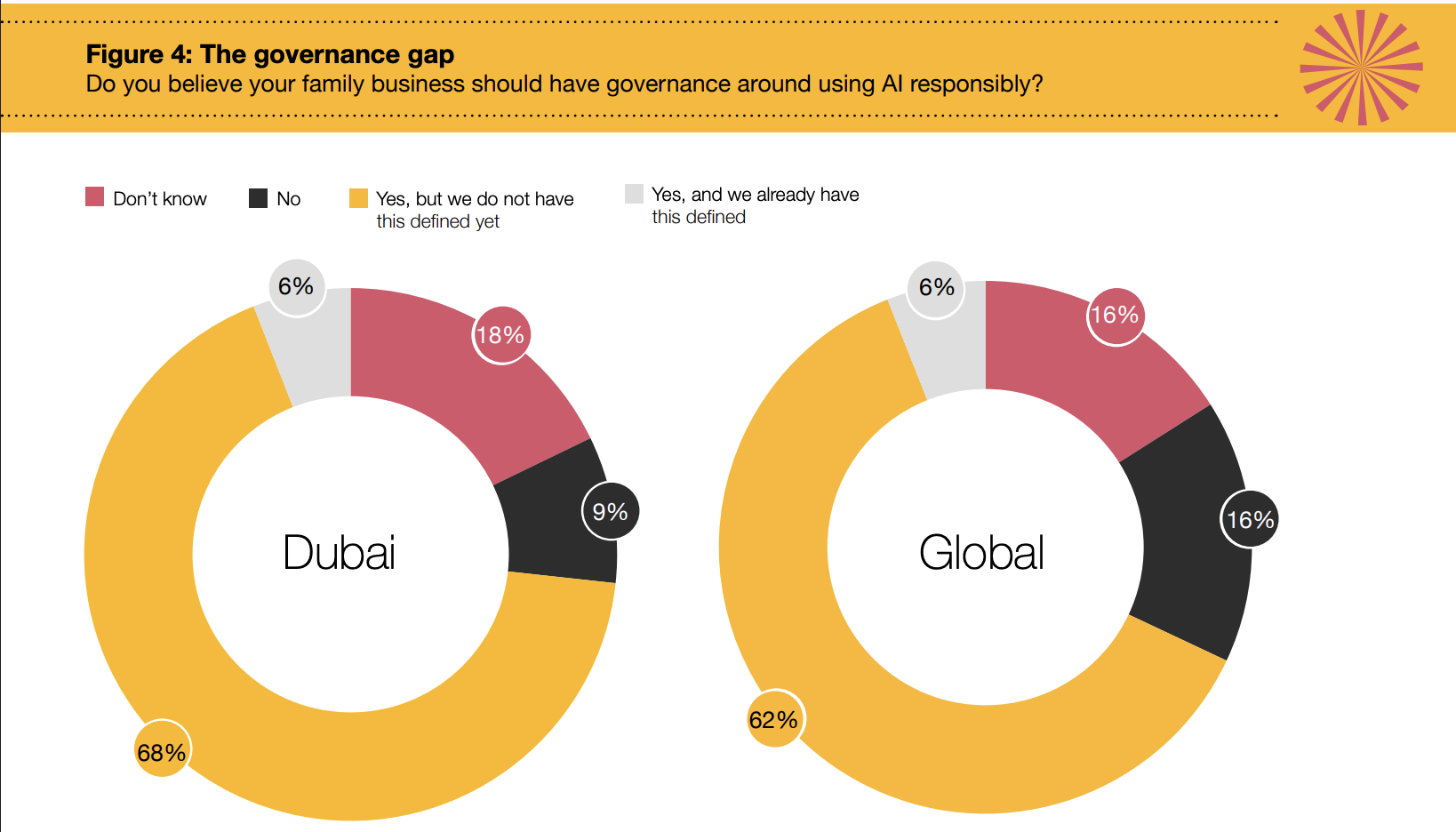
The research makes this tension clear: when the NextGen is treated as “the innovation team” rather than being embedded in transformation governance, digital becomes peripheral. When the reverse happens — enthusiasm without operating discipline — digital becomes theatre. [10] [11]
What Family Businesses Are Really Resisting
What many family businesses resist is not software. It is redesign.
Digital transformation changes what counts as evidence. It changes who gets to decide. It changes how quickly feedback travels. It changes whether intuition remains sufficient. It changes whether relationships remain the dominant operating infrastructure.
This is why transformation can feel disproportionately uncomfortable in family firms. It interferes with inherited equilibria.
In one of the most useful formulations from the source material, digital transformation can be understood as an identity event in family enterprises: it changes what is measurable, who decides, and what must be professionalised. [6]
What a Better Approach Looks Like
A better approach begins by reframing digital transformation as a governance programme first, not an IT initiative. Because it changes decision rights around data, experimentation, and investment, it has to be anchored at the owner and board level. [8]
Family businesses also need a three-layer transformation map. Every digital investment should be examined across three questions:
- Value creation: What changes in revenue, margins, or customer value?
- Operating model: What changes in roles, processes, and incentives?
- Capability systems: What changes in data, cyber, talent, platforms, and learning loops?
This prevents superficial work from being mislabeled as transformation. [11]
MENA family groups also need a cross-generational transformation compact — not a vague conversation about the future, but a formal agreement about which parts of the business will be modernised, which will be reinvented, how risk is shared, what metrics define success, and where the NextGen has real authority. [10] [11]
Finally, transformation must be measured by capability adoption and learning speed, not just project completion. If transformation is strategic renewal, the leading indicators cannot be limited to milestones. They have to include adoption, cycle time, customer outcomes, and the speed at which the organisation learns. [3] [11]
The Real Question
So why do family businesses misunderstand digital transformation in MENA?
Because they often think the problem is technological when it is actually structural. Because they seek modernization without redistribution of decision-making. Because they want new capabilities without new governance. Because they want innovation without destabilizing the legacy logic that made them successful.
The family businesses that will shape the next decade in MENA will not be the ones that buy the most tools. They will be the ones that develop the institutional courage to redesign how the business works.
Not because they abandoned legacy. Because they learned how to renew it.
References
- Vial, G. Understanding Digital Transformation: A Review and a Research Agenda. https://www.sciencedirect.com/science/article/abs/pii/S0963868717302196
- Gong, C. & Ribiere, V. Developing a Unified Definition of Digital Transformation. https://www.sciencedirect.com/science/article/abs/pii/S0166497220300894
- Warner, K. S. R. & Wäger, M. Building Dynamic Capabilities for Digital Transformation. PDF Link
- Emirates News Agency / UAE government reporting on family businesses’ contribution to GDP and employment. https://www.wam.ae/en/article/bmlj11e-family-businesses-contribute-60-uae-gdp-says
- HSBC Global Private Banking & Campden Wealth. The MENA Family Office Landscape Report 2024. PDF Link
- Bouncken, R. B. et al. Family firms’ digital transformation: pathways and tensions. https://link.springer.com/article/10.1007/s11187-025-01146-8
- OECD. Corporate Governance in MENA. PDF Link
- Recommendations and governance framing from the uploaded research synthesis. See underlying regional governance sources above and source synthesis in the uploaded research document.
- PwC Middle East. Family Business Survey 2023. PDF Link
- PwC Middle East. NextGen Survey 2024: A Dubai Focus. PDF Link
- Research synthesis and recommendations in the uploaded source document, drawing on the above academic and regional sources.